
Granite mausoleum construction is the process of taking a family memorial area from approved site data and drawings through component fabrication, transport, installation and final acceptance. Unlike a single grave monument, a mausoleum or family memorial cluster usually contains multiple interrelated elements, so layout, levels, construction sequence and site access need to be controlled from the beginning.
This page focuses on granite mausoleum construction and installation, from existing-condition checks and foundations to granite fabrication, transport and final acceptance. If the main need is to develop the design before construction, see family mausoleum design; if you are selecting a product configuration, see the KANNO granite mausoleum collection.
Related service groups are summarized on the KANNO services page.
What is included in granite mausoleum construction?
- site survey, levels and access review;
- foundation or existing-condition treatment according to the project documents;
- grave monuments and primary granite components;
- a central memorial shrine or worship area where included;
- gates, fences and stone spirit screens where shown in the design;
- steps, paved areas, paths and coordinated granite elements;
- headstones, lettering and accessories included in the contract scope;
- transport, installation, cleaning and final acceptance.
Not every “turnkey” package automatically includes all of these items. The exact scope should be defined by the approved drawings and quotation for each project.
Granite mausoleum construction process
1. Check the site and approved drawings
Verify the plot dimensions, boundaries, levels, existing graves and transport route. If actual site conditions differ from the design data, the discrepancy should be resolved before mass fabrication begins.
2. Confirm levels and foundation work
Finished levels affect paths, steps, grave monuments and the central worship area. Foundation design should respond to the actual ground conditions rather than applying one standard detail to every project.
3. Fabricate granite components
Components are cut, shaped and surface-finished according to the approved drawings. For assemblies made from several pieces, related dimensions should be checked as a set to reduce cumulative site errors.
4. Pack and organize transport
Weight, component dimensions, access, unloading position and lifting equipment should be planned in advance. Packing sequence should support the installation sequence so that heavy components do not need to be moved repeatedly on site.
5. Install to established axes and levels
Main axes are set out first, followed by graves, the worship area, gates, fences and secondary elements. Continuous level checks help prevent cumulative misalignment across multiple components.
6. Finish and complete final acceptance
Primary dimensions, positions, surfaces, joints, headstones and all agreed items are checked against the approved project documents. Acceptance should be based on the finalized drawings rather than only on visual renderings.
How is mausoleum construction different from a full family memorial complex?
| Scope | Mausoleum / memorial cluster | Family memorial complex |
|---|---|---|
| Main focus | Grave monuments, worship area and stone components | The entire memorial environment |
| Landscape | May be included but is not always central | May include planting, garden areas, water features, seating and memorial buildings |
| Construction coordination | Prioritizes axes, levels and stone components | Requires coordination across landscape and additional work packages |
If the scope expands into a complete memorial environment, see family memorial complex design and construction.
Which granite is suitable for a mausoleum?
KANNO commonly uses black and green granite for grave monuments and primary components. Lighter colors may be introduced selectively for fences, balustrades, shrines or landscape elements when appropriate to the design. Raw material consistency, block or slab dimensions and specified surface finish should be checked before production.
What affects the cost of granite mausoleum construction?
- site area and number of graves;
- granite type and component specifications;
- complexity of the worship structure, gates and fences;
- foundation conditions and site levels;
- headstone, lettering and detail fabrication quantities;
- transport distance and access conditions;
- lifting equipment and installation constraints;
- work outside the stone scope.
Two quotations should not be compared only by total price when their material specifications and work scopes differ.
Common granite mausoleum construction mistakes
- starting fabrication before the site is remeasured;
- failing to establish one common level datum for the whole complex;
- designing components too large for actual site access;
- installing individual elements without maintaining the overall axes;
- ignoring drainage and maintenance clearances;
- changing stone or dimensions on site without updating the project documents;
- accepting the work against a rendering rather than the approved drawings.
KANNO project references for mausoleum construction
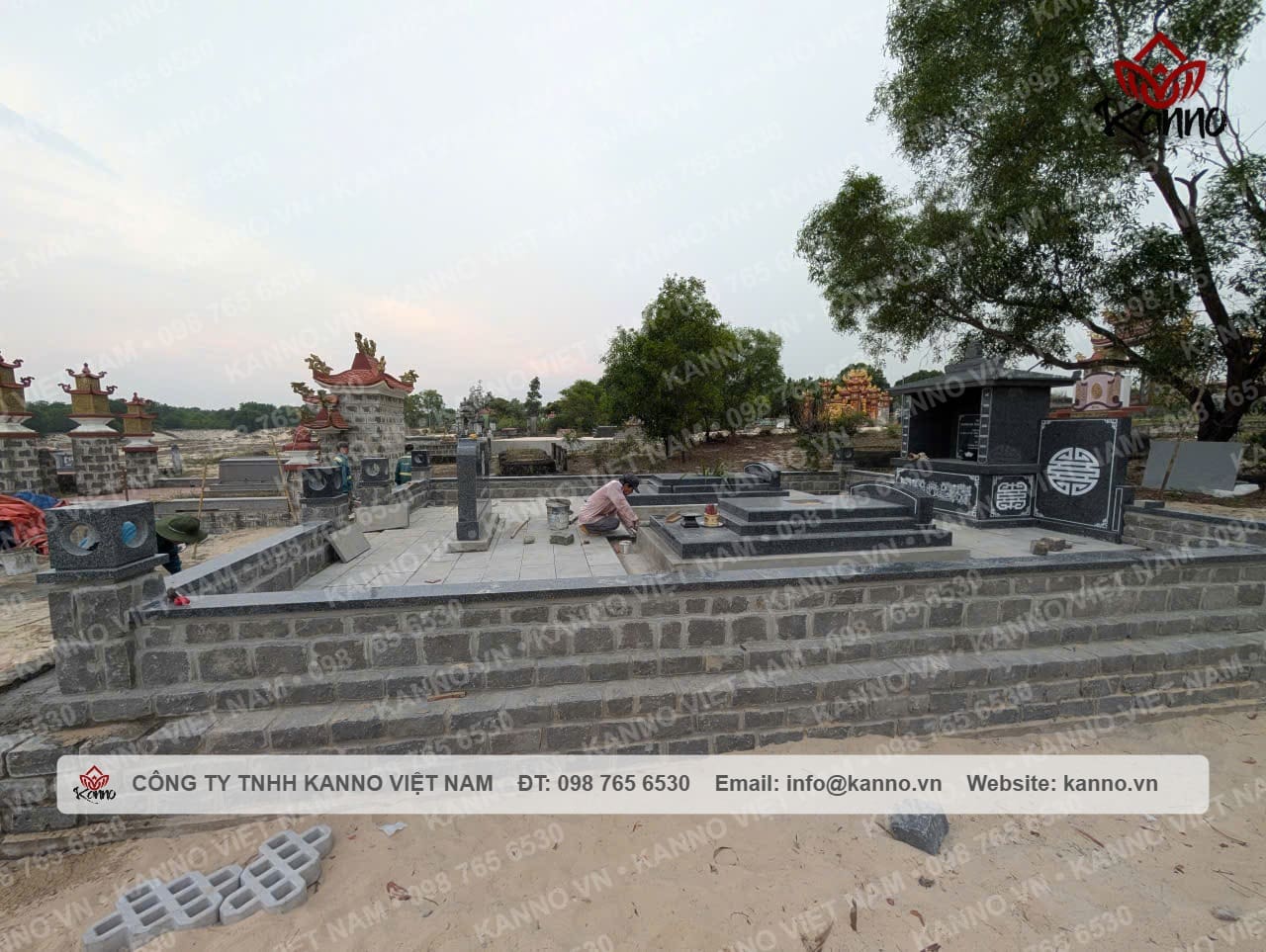
The granite family mausoleum project in Quảng Trị records an overall size of 8,500 × 9,200 mm and includes a memorial shrine, granite graves, a spirit screen and perimeter walls. It illustrates why multiple elements sharing one site must be coordinated as one system, with axes, levels and installation sequence established before site work.

Another reference is the granite mausoleum complex at Vĩnh Hằng, Ba Vì, recorded in the project data at 8 × 10 m and using Bình Định black granite. Because the two projects have different configurations, dimensions and construction scope must be determined separately for each site. When preparing the layout, see family mausoleum dimensions; for the central worship structure, see granite memorial shrines.
Frequently asked questions
Not automatically. Foundation work should be defined according to the actual site conditions and stated clearly in the project scope.
Yes, provided the drawings are reviewed for dimensions, materials, construction details and transport and installation feasibility before production.
Yes, provided the existing-condition data, access route, unloading area and installation sequence are confirmed before production.
They overlap, but the scope is different. A family memorial complex is generally broader and may include landscape, memorial buildings and multiple functional zones beyond the main stonework.