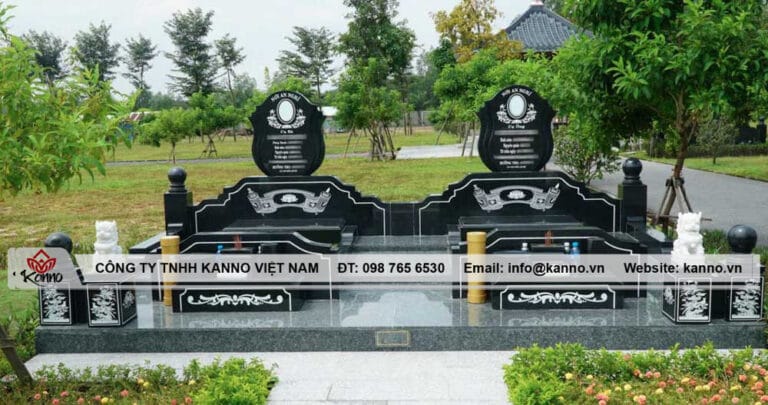
A granite-clad grave uses a masonry or concrete core finished with thinner granite facing pieces. This can provide flexible initial cost and may suit some renovation work, but it creates a multi-layer system: foundation, structural core, bonding layer, granite facing and joints.
KANNO generally favors substantial granite components for new memorial construction where the site, design and budget allow, because this reduces dependence on thin facing layers. This is a project preference rather than a claim that every granite-clad memorial will fail.

How the two systems differ
- Granite cladding: masonry/concrete core provides the primary substrate, with granite as the finish layer.
- Substantial granite components: thicker granite pieces form the main visible memorial body, steps, headstone or other principal elements.
1. More joints need to be controlled
A cladding system normally contains more facing joints. Changes in temperature, moisture, substrate shrinkage or small foundation movement can concentrate stress around joints and corners. This does not mean cracking is inevitable; it means the system has more interfaces that require good detailing and maintenance.
2. Headstones can be sensitive to support movement
A large upright slab relies on stable support. If its base, substrate or connection moves unevenly, local stress can develop around edges, corners or fabricated openings. Appropriate thickness, support and installation are therefore important regardless of the system.
3. The complete system matters more than granite alone
Granite itself is widely used outdoors. In a cladding system, however, performance also depends on the substrate, bonding layer, joints, drainage and installation. Substantial granite components reduce some of those intermediate layers but still require a stable foundation and correct assembly.
| Criterion | Granite cladding | Substantial granite components |
|---|---|---|
| Main construction | Masonry/concrete core + bonding + facing | Thicker granite components |
| Facing joints | Generally more | Generally fewer, depending on segmentation |
| Bond-layer dependency | Yes | No thin facing layer using the same mechanism |
| Transport | Smaller pieces can be easier to move | Heavy pieces require access and lifting review |
| Initial budget | Can be more flexible | Often higher for the same scale |
| Typical use | Renovation or constrained-access situations | New construction where long-term component stability is prioritized |
4. Where cladding has practical advantages
- renovating an existing stable core;
- narrow access where large components cannot be brought in;
- projects where budget requires a lower initial stone quantity;
- secondary surfaces that do not need substantial stone construction.
5. Main areas to monitor in a cladding system
- joints opening or cracking;
- loss of jointing material;
- water entering behind facing pieces;
- hollow-sounding areas indicating reduced bond;
- chipped or cracked corners;
- movement transferred from the substrate.
6. Advantages of substantial granite components
- reduced dependence on a thin facing bond layer;
- fewer facing joints;
- clear component thickness and dimensions in the fabrication drawings;
- suitable for new construction where foundation and component support can be designed together.
7. Substantial granite also has trade-offs
Heavy components cost more initially in many configurations, require appropriate transport and lifting, and still depend on a stable foundation. Large pieces also need accurate fabrication because site modification is more difficult than trimming small facing pieces.
8. Initial price is not the only comparison
When comparing systems, include the full construction and likely maintenance scope, not only initial stone quantity. A lower initial cost may be rational for a renovation or constrained site; a more substantial granite system may be preferable for a new project where reducing joints and intermediate layers is a priority.
When might KANNO still consider granite cladding?
- an existing memorial has a stable substrate and only the finish is being renewed;
- access is too restricted for large granite components;
- the project budget does not support substantial granite throughout;
- secondary components only require a finish layer.
Frequently Asked Questions
No. For new work, KANNO generally prefers substantial granite components where technically and financially suitable, while cladding remains valid for specific constraints or renovation cases.
No. Cracking is not inevitable. Risk depends on the foundation, substrate, bonding, joints, drainage, material and workmanship.
Yes. No stone or construction system is absolutely immune to damage. Stone quality, foundation stability and correct installation still matter.
Not necessarily. The appropriate choice depends on project conditions, initial budget, maintenance expectations and actual construction quality.