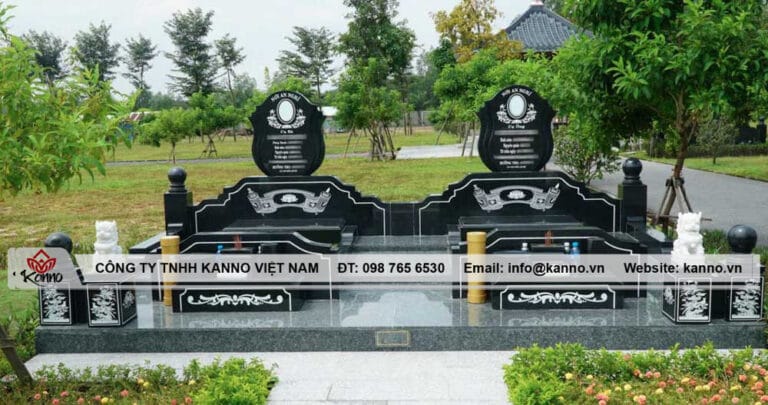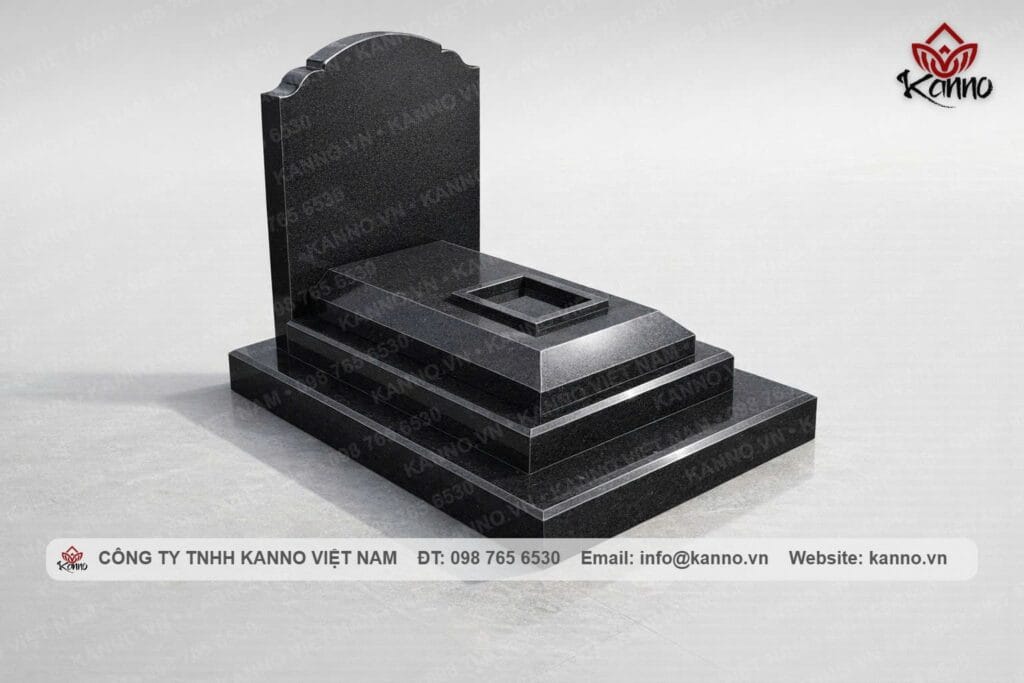
Stepped granite memorials use several horizontal levels to build the base and visual transition from ground to memorial body. “Three-tier” describes the architectural form, not the burial method; the same design language can be adapted for reburial/cremation or in-ground burial when dimensions and internal construction are resolved correctly.

What defines a stepped memorial?
The levels may appear in the base, plinth or transition to the memorial body. Their widths and heights should be proportioned together rather than added as decorative strips. Larger projections increase the footprint and affect circulation around the grave.
Why granite suits stepped forms
Granite can produce crisp horizontal edges and broad flat surfaces. Indian Black Granite is common in KANNO examples because it emphasizes the layered geometry and works well with polished contemporary finishes.
Three-tier does not mean in-ground burial
A stepped design can be developed for different burial methods. The decisive information is the grave opening, urn/ossuary or burial construction, not the number of visible tiers.
How to proportion the tiers
- the lowest tier should suit the actual plot and required circulation;
- successive tiers should create a clear transition without making the body top-heavy;
- step heights need to work with the total memorial height and headstone;
- projecting edges should not obstruct nearby paths or graves.
Construction and installation
Each granite tier may be formed from one or more substantial components depending on dimensions and transport constraints. Accurate contact surfaces, foundation level and alignment are important because errors at the lower tiers accumulate upward.
How to choose a stepped granite memorial
- Confirm burial method.
- Measure the plot and below-ground requirement.
- Select a reference stepped design.
- Adjust tier widths, heights and projections to the actual site.
- Select granite and finish.
- Check component weight and installation access.
- Approve drawings before fabrication.
Frequently Asked Questions
No. Three-tier describes the architecture. Burial type is determined by the internal construction and dimensions.
No. Indian Black Granite is a common KANNO choice, but other suitable granites can be used.
Not necessarily. Individual tiers and other elements are commonly fabricated as separate substantial components and assembled together.