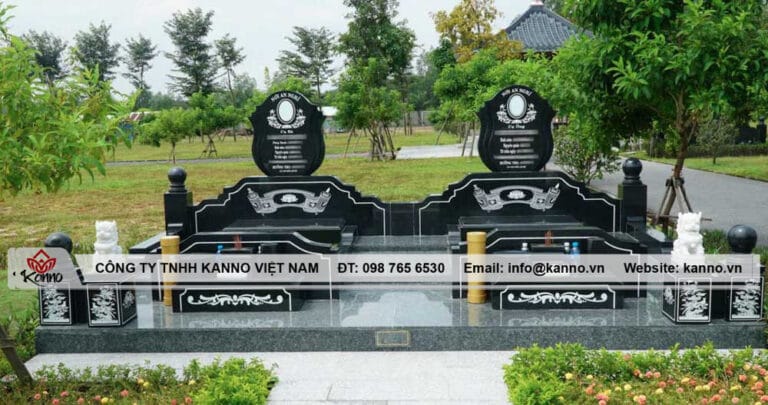
Granite headstones carry memorial information and strongly influence the proportion, focal point and visual language of the complete grave monument. A successful headstone depends not only on stone color or typeface but also on its relationship to the memorial body, viewing distance, amount of text, engraving method and installation.
If the family is selecting a complete upright-headstone memorial, see upright-headstone granite memorials. For lettering and production methods, see granite headstone lettering.

Common granite headstone types
Separate upright headstone
Fabricated as an independent component and installed at the head of the grave. This provides flexibility for fabrication or future replacement, but the support and connection still need to be designed correctly.
Integrated headstone
The headstone forms part of the memorial-body composition. This creates a more unified appearance but requires accurate dimensions from the start.
Low or minimalist headstone
Suitable for contemporary, flat-roof or Japanese-inspired designs with restrained decoration.
Curved or shaped headstone
Top edges or outlines may be shaped according to the design, while maintaining sufficient clear space around text and portraits.
Why granite works well for headstones
Granite has a hard surface that can be polished and provides strong contrast with engraved or infilled lettering. Actual performance still depends on the granite, slab or block quality, thickness, edge fabrication, connection and installation.
Indian Black Granite is often selected where strong contrast with light or gold lettering is desired. Lighter stones can support a softer overall composition.
How should headstone dimensions be chosen?
- memorial width and length;
- overall memorial height;
- viewing distance from the path;
- amount of text to be engraved;
- portrait position where used;
- memorial type: reburial, in-ground burial, double or family memorial.
A headstone that is too small can become difficult to read; one that is too large can dominate the body. Review the headstone on the complete elevation before production.
What information can be shown?
Depending on family custom, content may include the name, birth and death dates, hometown, family information, memorial wording, portrait, religious symbols or selected motifs. The priority should be legibility rather than forcing too much information onto a small surface.
Lettering layout principles
- Information hierarchy: keep the name visually dominant and supporting lines smaller.
- Edge clearances: do not place text or portraits too close to the stone edge.
- Typography: limit the number of different typefaces.
- Artwork approval: check spelling, dates, portrait and alignment before engraving.
Engraving methods
Depending on granite and finish requirements, lettering can use sandblasting, CNC, hand work or painted/gold-leaf finishing. The key is to control depth, edge clarity and contrast. The artwork should be approved before permanent fabrication begins.
Headstones with or without portraits
A portrait should be included in the layout from the start so the name and dates are not compressed around it. Without a portrait, the available area can be used for stronger text hierarchy or a restrained symbol. These are layout variants of the same headstone-design problem rather than separate SEO topics.
Black vs. lighter granite
| Criterion | Black granite | Gray / lighter granite |
|---|---|---|
| Contrast with light lettering | Typically strong | Depends on lettering color |
| Visual character | Dark, formal and visually strong | Lighter overall composition |
| Material selection | Check consistency and surface quality | Check batch consistency and grain |
Coordinate the headstone with the memorial
Stone color, edge treatment, proportion and design language should relate to the memorial body, altar table and surrounding site. In double or family memorials, consistent headstone rules help the entire complex remain visually organized.
Frequently Asked Questions
Yes, granite is widely used outdoors, but long-term performance also depends on stone quality, thickness, connection, engraving and installation.
Yes. The result depends on source-image quality, granite and production method, so approve a mock-up before fabrication.
Both are valid. A separate headstone can be easier to fabricate or replace; an integrated headstone creates a unified composition but needs more accurate upfront design.