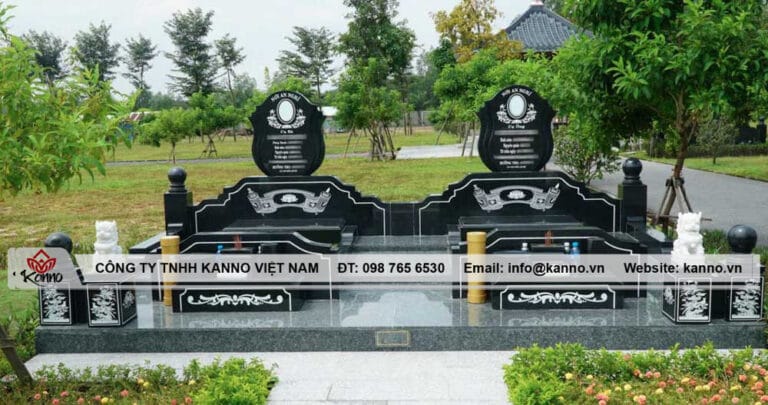
Solid granite memorial cost cannot be reduced to one universal figure. The actual budget depends on granite type, memorial dimensions, component thickness, fabrication, headstone work, foundation, transport, lifting and installation. Quotations should therefore be compared on the same technical configuration rather than by total price alone.

What makes up the total cost?
- Granite: stone type, trade name, color, raw dimensions and availability.
- Dimensions: width, length, height and actual thickness of each component.
- Fabrication: cutting, shaping, polishing, edge work, drilling, CNC or other detail work.
- Headstone and lettering: headstone size, inscription, portrait and finishing where required.
- Foundation: existing condition, levels and support required for heavy components.
- Transport: distance, road access, component weight and lifting equipment.
- Installation: setting out, alignment, assembly and final finishing.
Which factors influence cost most?
Granite specification
Different granites do not carry the same raw-material cost or available block sizes. Large solid components require suitable raw stone, so the material should be identified precisely rather than described only as “black granite” or “white granite.”
Memorial dimensions
Larger dimensions increase stone quantity and can change transport and lifting requirements. Reburial/cremation memorials and in-ground burial memorials should not be compared as if they have the same construction.
Surface finish and detail work
Polishing, shaped edges, curved pieces, technical openings, lettering and engraved details all require different fabrication time and processes. For Indian granite fabricated in Vietnam, KANNO distinguishes Polished from India Plus – Super Polished; these should not be treated as the same specification.
Site conditions
Cemetery access, distance from vehicle to grave, crane or lifting access and foundation condition can materially change installation cost even when the memorial design is the same.
What does “solid granite” mean?
It does not necessarily mean every part is carved from one single block. Many memorials use several substantial granite components fabricated separately and assembled according to drawings. Quotations should identify the relevant component dimensions and thicknesses.
Solid granite vs. granite-clad construction
| Criterion | Solid / substantial granite components | Granite-clad construction |
|---|---|---|
| Main construction | Granite components form the primary visible assembly | Masonry/concrete core with granite facing |
| Stone quantity | Greater | Lower, with thinner facing pieces |
| Narrow-site installation | Requires access and lifting checks | Can be more flexible in some conditions |
| Surface joints | Fewer depending on component segmentation | Generally more facing joints |
| Initial cost | Often higher for the same scale | More flexible depending on configuration |
How to prepare for a quotation
- Confirm reburial/cremation or in-ground burial.
- Measure the plot, grave opening and usable circulation.
- Select a memorial type: upright headstone, stepped, roofed, single or double.
- Select the granite and required finish.
- Prepare at least preliminary overall dimensions and component concept.
- Check transport and lifting access.
- Request an itemized quotation covering material, fabrication, lettering, foundation, transport and installation.
How to compare quotations correctly
- same granite specification;
- same dimensions and component thicknesses;
- same headstone and lettering scope;
- same foundation and transport assumptions;
- same lifting, installation and finishing scope.
A lower total that excludes several items is not directly comparable to a quotation covering the full project.
Information to send KANNO
- site photographs;
- plot and grave-opening dimensions;
- burial method;
- reference design;
- preferred granite;
- project location;
- headstone, lettering and accessory requirements.
Frequently Asked Questions
Not by square meter alone. Component thickness, weight, fabrication, transport and installation are major cost factors.
Initial cost is often higher for the same scale because more stone and heavier components are used, but the comparison must use the same granite and project scope.
Only very roughly. Dimensions, granite, location and work scope are needed for a more meaningful quotation.
Not necessarily. The quotation should state clearly what is included and excluded.