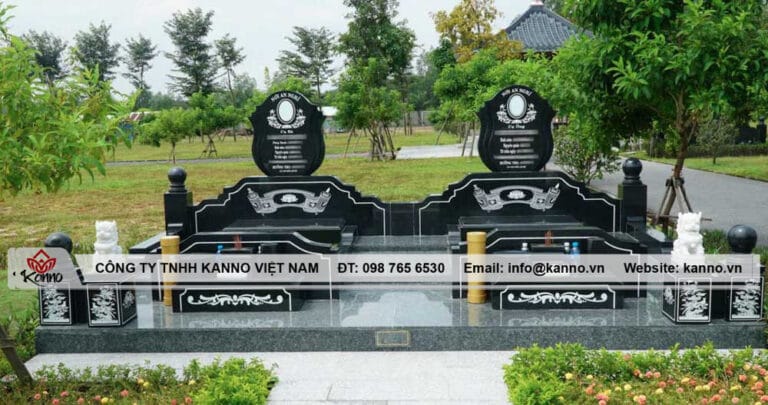
Turnkey granite memorial construction covers the complete process from site survey and approved drawings through material selection, fabrication, transport, installation and final acceptance. At KANNO, the actual scope is defined for each project rather than assumed from a single fixed package.
If your main goal is to compare product designs, see granite memorials. This page focuses on the construction service, work scope and how a project progresses from drawing to handover.
What can turnkey granite memorial construction include?
- Site survey: plot dimensions, grave opening where already constructed, levels, access and cemetery requirements.
- Design: plan, memorial dimensions, levels, headstone position, component construction and related work.
- Material selection: granite type, stone color, component specification and surface finish.
- Fabrication: cutting, shaping, edge finishing, surface treatment and headstone work to approved drawings.
- Transport: packing and transport planning according to component size, weight and site access.
- Installation: setting out, level control, component placement, joint finishing and final adjustment.
- Acceptance: check the main dimensions, position, surface finish and agreed work items before handover.
Foundations, paving, fences, altar tables, spirit screens or other site works should be stated separately in the drawings and quotation rather than assumed to be included.
KANNO construction process
1. Survey existing conditions
Plot dimensions, access, ground level and any existing grave opening should be confirmed before a model is finalized. Large solid-granite components also require enough working space and a realistic unloading or lifting plan.
2. Approve technical drawings
Overall dimensions, grave-body construction, headstone location, stepped elements and technical clearances should be agreed before fabrication.
3. Select granite and finish
Stone should be selected from actual material references where possible. Color, grain consistency, component dimensions and surface finish all matter; screen images alone are not sufficient for final material approval.
4. Fabricate to the approved drawings
Related components should be checked as a set so their dimensions work together during installation. Headstone content and portrait details can be finalized at the appropriate stage before engraving.
5. Pack and transport
Component dimensions, weight, cemetery access, unloading position and installation order should be considered before dispatch.
6. Install and align
The installation team verifies the base, level and centerline before placing the primary components. Joints and final finishing are completed after the assembly is stable.
7. Final acceptance
The completed work should be checked against the approved drawings and quotation scope, not only against a rendered perspective.
Construction considerations by memorial type
| Type | Main installation considerations |
|---|---|
| Single granite memorial | Centerline, headstone-to-base proportion, levels and working clearance. |
| Double granite memorial | Alignment of both burial positions, common levels and symmetry. |
| Solid-granite memorial | Component weight, lifting equipment, transport route and positioning accuracy. |
| Roofed memorial | Roof construction, connection points, total height and installation sequence. |
| Stepped memorial | Level of each step, base flatness and dimensional relationship between layers. |
Foundations and levels
Granite components can be heavy, so the supporting ground and foundation need to suit the actual project. One standard foundation detail should not be applied automatically to every site. Where an existing grave opening or foundation has already been built, its position and level should be measured before production drawings are finalized.
Working in another province
Remote projects depend on accurate information before fabrication: plot dimensions, current photographs, access route, unloading position and an on-site contact. Standardizing this information before production makes transport and installation easier to control.
When does the scope become a family memorial complex?
If the project includes several graves, a worship area, gates, fences, paths, planting or landscape work, it should be managed as one coordinated memorial complex rather than as a collection of unrelated items. See Japanese memorial garden design or KANNO’s broader family memorial complex service.
What should a quotation state?
- granite type and material specification;
- dimensions and number of components;
- fabrication details and surface finish;
- headstone, lettering and accessories where included;
- transport and delivery conditions;
- whether foundation work is included;
- installation and finishing scope;
- acceptance criteria and how variations are handled.
Information to prepare before requesting construction
- location and cemetery name, if applicable;
- plot dimensions;
- grave-opening dimensions if already constructed;
- current photographs and access information;
- burial method;
- reference design or style;
- other site elements to be coordinated;
- preferred project timing.
Frequently Asked Questions
No. Foundation work must be defined from actual conditions and stated explicitly in the project scope or quotation.
Yes, after the drawing has been reviewed for dimensions, material, construction and fabrication and installation feasibility.
Before production drawings are approved. Differences in position or level can directly affect memorial construction and installation.
Larger and heavier components require more careful review of access, unloading position and lifting equipment before fabrication dimensions are finalized.