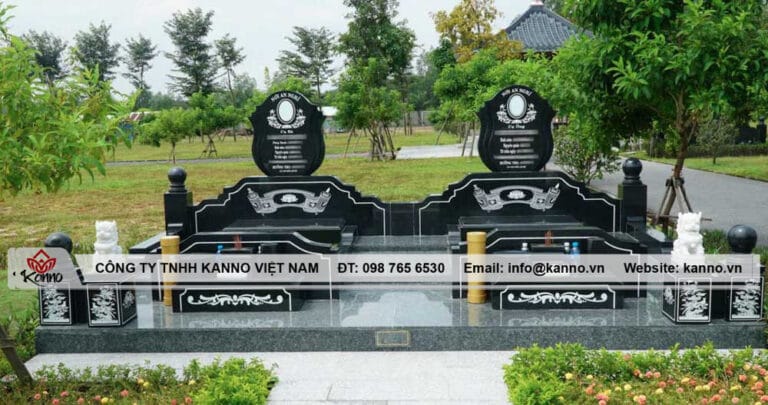
Granite memorials for reburial and cremation are grouped together by KANNO when the memorial is intended for cremated remains or an ossuary used after reburial. Before selecting a model, confirm the memorial-body width, urn or ossuary dimensions and the actual plot. Overall headstone height does not determine whether a memorial belongs to the reburial or in-ground burial group.
Common KANNO reburial / cremation configurations
Within KANNO’s current system, compact models around 810 mm in body width are commonly used as references for reburial or cremation. For example, a model recorded at 810 × 680 × 1250 mm is classified from its 810 mm width and construction; the 1250 mm figure is overall height and does not define the burial method.


How should the dimensions be determined?
| Factor | Why it matters |
|---|---|
| Memorial-body width | An important reference for KANNO’s compact reburial/cremation product group. |
| Urn or ossuary dimensions | Determine the internal clearance and construction required. |
| Memorial length | Must suit the product construction and plot but should not be used alone to classify the burial method. |
| Overall height | Affects the proportion of headstone, body and steps; it does not determine reburial versus in-ground burial. |
| Plot and cemetery rules | Set the practical limits before drawings are approved. |
Reburial / cremation vs. in-ground burial
Reburial or cremation memorials can be more compact because they contain cremated remains or an ossuary. In-ground burial requires the grave opening, coffin, surrounding construction and installation space to be resolved differently. See the separate guide to granite memorials for in-ground burial.
How to choose a reburial granite memorial
- Confirm whether the memorial is for cremation or reburial and measure the urn or ossuary.
- Measure the plot and check cemetery limits.
- Compare models within the feasible width group; around 810 mm is a common KANNO reference, not a mandatory standard.
- Select the visual type: upright headstone, minimalist, stepped or solid-granite configuration.
- Approve technical drawings first, then compare dimensions with the Lỗ Ban ruler if the family uses that cultural reference.
Frequently Asked Questions
Yes. KANNO groups them together where both use compact configurations for cremated remains or an ossuary after reburial. Final internal dimensions still depend on the actual container and plot.
No. Classification depends on construction, body dimensions, what the memorial contains and the actual burial method.
No. It is a common width group in KANNO’s current products, not a universal standard.