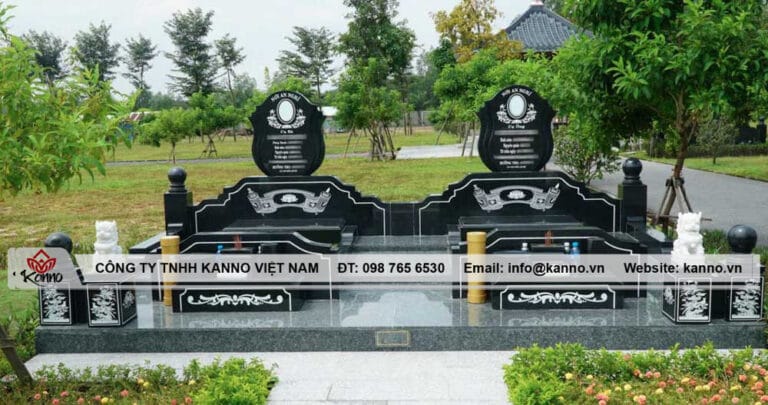
Solid granite memorials use substantial natural-granite components fabricated and assembled into a complete memorial. “Solid granite” does not necessarily mean the entire monument is carved from one single stone block. The base, body, headstone, cover or individual steps may each be separate solid-stone components assembled according to the drawings.
For a broader overview of memorial types, see KANNO granite memorials.
What does “solid granite” mean in practice?
Major elements are fabricated from granite slabs or blocks with their own structural thickness instead of being only a thin decorative facing over a masonry core. The exact construction varies by product.
When comparing quotations, ask:
- which components are thick solid-stone pieces;
- which components are fabricated slabs;
- the actual thickness of each part;
- where joints occur;
- whether any masonry or concrete is used inside the assembly.

Advantages of substantial granite construction
Clear massing and crisp edges
Granite works well with flat planes, square edges, upright headstones and defined stepped bases. Accurate fabrication gives the assembly a clean and substantial appearance.
Controlled surface finish
Surfaces can be honed or polished according to the granite and design. Polishing can deepen the apparent stone color and make routine cleaning easier.
Material consistency
The same granite can be used across the base, body, headstone and related components to create a consistent visual system.
Applicable to different burial types
Solid-granite construction can be used for both compact reburial/cremation memorials and larger in-ground burial configurations. “Solid granite” describes construction, not the burial method.
Selected KANNO examples


Indian Black Granite and other stone options
KANNO uses Indian Black Granite in many solid-granite products because its dark appearance suits restrained contemporary forms. Solid construction does not require black granite, however; other stones can be used where their available dimensions and properties suit the design.
For Indian stone fabricated in Vietnam, KANNO distinguishes the standard Polished finish from the India Plus – Super Polished line. These should not be treated as identical specifications.
How should dimensions be determined?
- Confirm reburial/cremation or in-ground burial.
- Measure the urn, ossuary, grave opening or coffin-related space as applicable.
- Check cemetery rules and setbacks.
- Develop the base, body and headstone dimensions together.
- Check access, lifting equipment and component staging.
- Approve drawings before cutting the stone.
What determines quality?
Component thickness
Thickness should suit the component dimensions and loads. Two products that look similar in photographs can differ significantly in construction.
Foundation
Heavy granite relies on a suitable base. Poor support can lead to movement or joint misalignment even when the stone itself is sound.
Joints and alignment
Because the memorial is commonly assembled from multiple solid-stone components, accurate contact surfaces and alignment are important.
Drainage
Horizontal surfaces and joints should avoid unnecessary water traps. Openings and stepped configurations need drainage considered at the design stage.
Solid granite vs. granite-clad masonry
| Criterion | Solid-granite construction | Granite-clad masonry |
|---|---|---|
| Main construction | Substantial stone components | Masonry or concrete core with granite facing |
| Stone thickness | Generally greater, depending on the component | Facing is typically thinner |
| Joints | Between stone components | Between facing pieces and substrate |
| Installation | Requires handling and lifting heavier stone | Depends more on site-built substrate work |
Frequently Asked Questions
Not necessarily. It usually consists of several substantial granite components—such as base, body, headstone and steps—fabricated separately and assembled together.
Yes. Solid-granite construction can be used for reburial, cremation and in-ground burial, with dimensions adapted to each case.
Yes. It is used in multiple KANNO products and works particularly well with restrained modern forms and polished surfaces.
No. Cost depends on granite, dimensions, thickness, number of components, finish, transport and actual installation conditions.